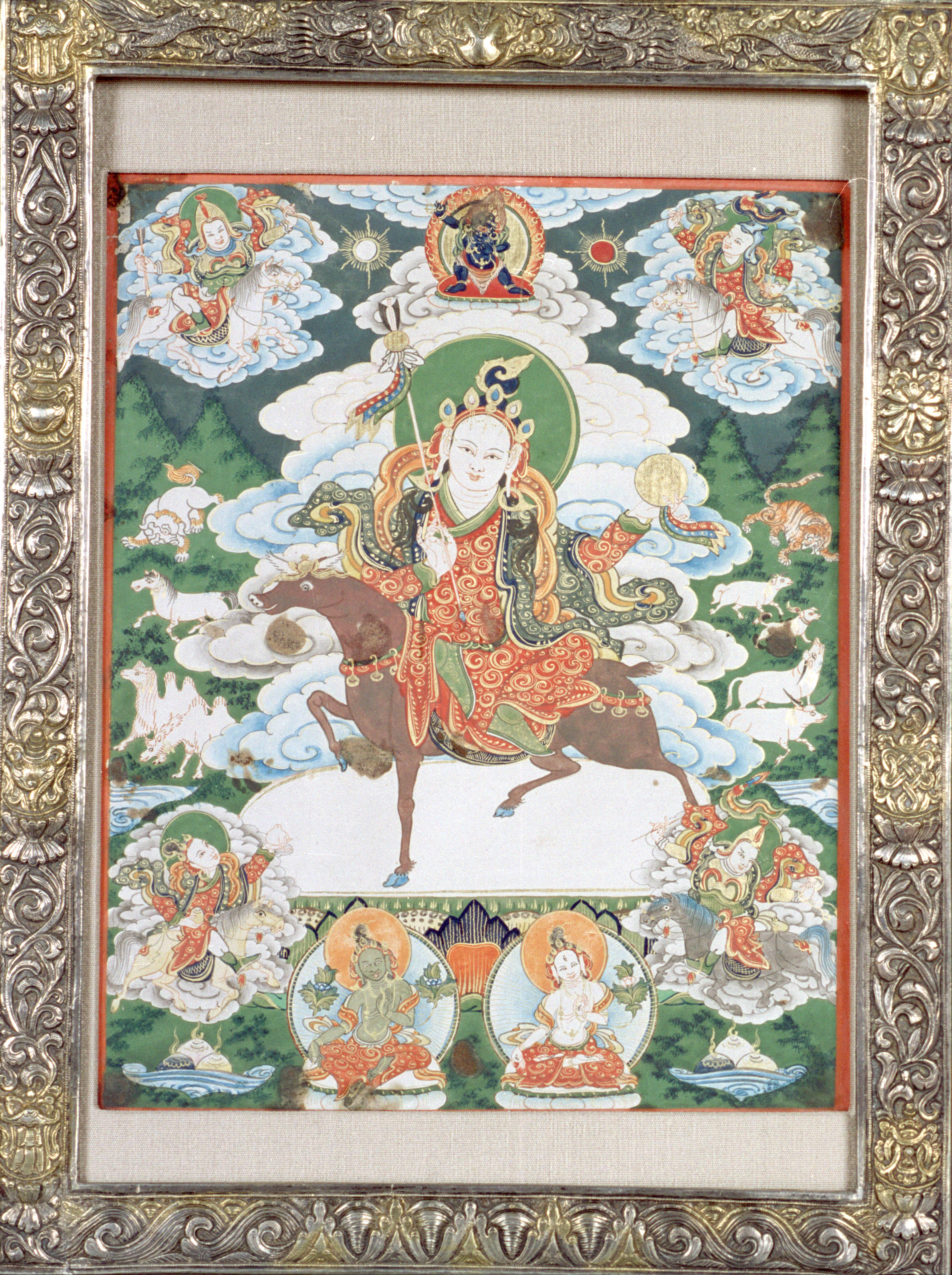
The Five Foremost Deities are believed to protect individuals in every aspect of their lives. In the centre is the White Goddess Mo lha (T. Mo lha), the only female in this group. She rides an antelope and holds a happiness-invoking arrow adorned with coloured silks and a divination mirror. She is surrounded by her four companions: the regional deity Yul lha (T. Yul lha) in the top left, the war god Dra lha (T. dGra lha) in the top right, the god of life Srog lha (T. Srog lha) in the bottom right and the male deity Pho lha (T. Pho lha) in the bottom left. Directly above on the clouds is Vajrapani, flanked by the sun and moon. At the bottom of the painting are Green Tārā and White Tārā flanked by auspicious offerings. On either side of Mo lha are various animals, including a snow lion, tiger, dog, cattle and camels. The Five Foremost Deities of the Individual are believed to be born at the precise moment of a person’s birth, residing with him or her throughout life. It is said that they promote virtuous deeds, protect the individual from all harm and are generally responsible for their health and well-being. The female deity, Mo lha, resides in a person’s left armpit and promotes wisdom and good looks; the regional deity, Yul lha, lives above the head and dignifies splendour. The war god, Dra lha, abides over the right shoulder for elevation of the spirit and the male deity, Po lha, is in the right armpit and grants prosperity. Finally, the god of life, Srog lha, dwells in the chest and promotes the virtues of the individual. The Five Foremost Deities have their origins in the preBuddhist beliefs shared by Mongolians and Tibetans.